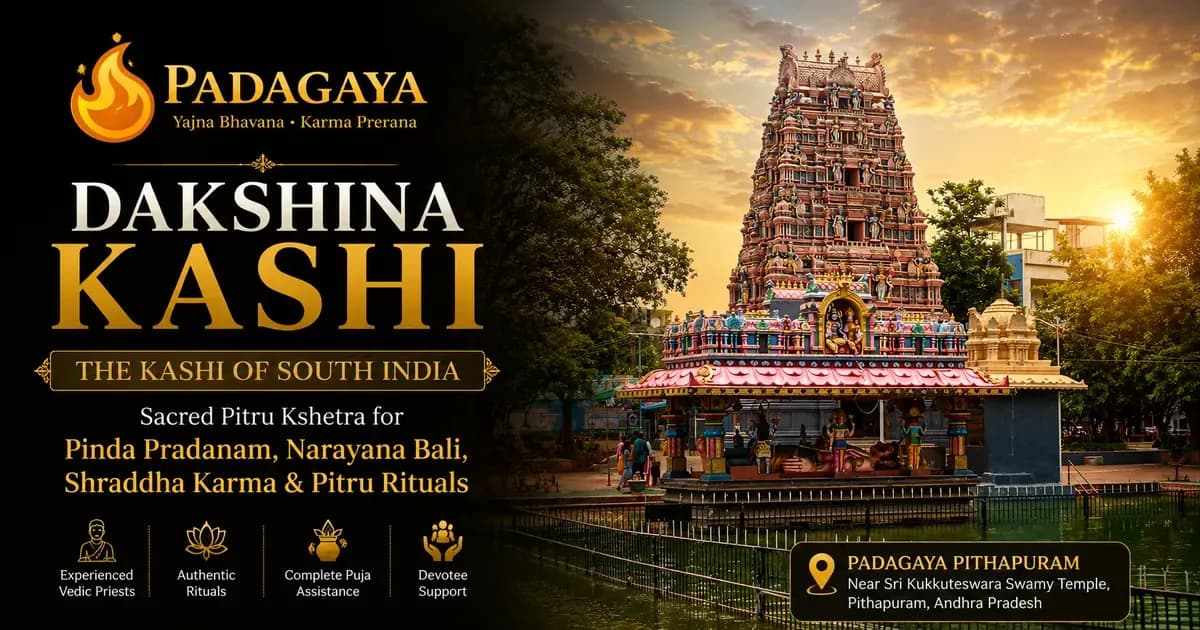
Vedic Knowledge

Padagaya Blog — Ancestral Rites, Vedic Rituals & Sacred Pithapuram

Performing ancestral rites correctly requires authentic knowledge. Our guides are written by Vedic scholars and ritual specialists who have spent decades at the sacred kshetras of Pithapuram, Gaya, and Kashi. Whether you are new to Pitru karma or seeking deeper understanding, these articles are your trusted reference.

Pitru Paksha 2026 ancestral rituals at Padagaya Pithapuram
Festival Guide
March 15, 20268 min read

Pitru Paksha 2026: Complete Guide to Ancestral Rituals at Padagaya

Pitru Paksha 2026 falls from September 7 to September 22. This sacred 16-day period, also called Mahalaya Paksha or Shraddha Paksha, is the most powerful time of the year to perform ancestral rites. At Padagaya in Pithapuram — the Pada Gaya of the holy trinity — rituals performed during Pitru Paksha are said to carry ten times the merit of those performed at any other time. In this complete guide, we cover which rituals to perform, auspicious tithis for 2026, how to prepare, what to bring to Pithapuram, and how NRI families can participate remotely. Whether you are performing Pinda Pradanam, Shraddha Karma, or Mahalaya Shraddha for the first time or the fiftieth, this guide answers every question.

Pinda Pradanam vs Shraddha Karma — differences explained
Ritual Guide
February 28, 20266 min read

Pinda Pradanam vs Shraddha Karma: What's the Difference?

Many devotees arrive at Padagaya unsure whether they should perform Pinda Pradanam or Shraddha Karma — or both. These two ancient Vedic rituals serve different purposes and are prescribed for different circumstances in the Dharmashastra. Pinda Pradanam is the offering of rice balls (pindas) to the ancestors to nourish their subtle bodies in the Pitru Loka, while Shraddha Karma is the annual ritual of homage and food offering performed on the death anniversary (tithi) of a parent or grandparent. This article explains the purpose of each ritual, when each should be performed, whether they can be combined, the correct procedure according to the Apastamba Sutra tradition of Andhra Pradesh, and which priests at Pithapuram are qualified to perform them. A clear comparison table is included for quick reference.

NRI families performing ancestral rituals remotely through Padagaya
NRI Guide
February 10, 20267 min read

How NRI Families Can Perform Ancestral Rituals Remotely from Abroad

Thousands of Hindu families settled outside India — in the United States, United Kingdom, Australia, Canada, Singapore, and the Middle East — face the same heartfelt dilemma: their ancestors have passed on, the Pitru Paksha arrives every year, and they cannot travel to India to fulfil their Vedic obligations. Padagaya was built precisely to solve this problem. Our team of experienced Vedic priests at Pithapuram performs Pinda Pradanam, Shraddha Karma, and Tarpanam on your behalf, sends you a live video of the ritual, and delivers the prasad by post. In this guide, we explain exactly how remote ritual services work, what information we need from you, how to provide the gotra and nakshatra details, how payments work from abroad, and how to ensure the ritual is performed at the correct tithi and muhurtam — even if you are 12 time zones away.

The sacred legend of Gayasura and Pada Gaya Pithapuram
Sacred History
January 22, 20269 min read

The Sacred Legend of Gayasura and Why Pithapuram is Pada Gaya

The legend of Gayasura is one of the most profound myths in all of Hindu cosmology — and it is the reason why Pithapuram, a small town in East Godavari district of Andhra Pradesh, is revered as one of the three holiest places for ancestral liberation on earth. According to the Vayaviya Samhita of the Shiva Purana and the Gaya Mahatmya sections of the Vayu Purana, the demon Gayasura performed extraordinary tapas (penance) and was granted a boon by Lord Vishnu that his body would purify all who touched it. The Holy Trinity — Brahma, Vishnu, and Maheshwara — performed a great Yagna on his body to stabilise the universe. When Gayasura's body was pressed into the earth, his head fell at Gaya in Bihar (Siro Gaya), his navel at Puri in Odisha (Nabhi Gaya), and his feet at Pithapuram in Andhra Pradesh (Pada Gaya). This article explores the complete legend, its Puranic sources, the significance of Lord Vishnu's paduka (divine footprint) at Pada Gaya Sarovar, and why completing rituals at all three Gayas is considered the ultimate form of Pitru Moksha.

Narayana Bali Puja for Pitru Dosha at Padagaya Pithapuram
Ritual Guide
January 5, 20267 min read

10 Signs You Need Narayana Bali Puja for Pitru Dosha

Pitru Dosha is one of the most misunderstood concepts in Vedic astrology and dharma. It is not merely a horoscope affliction — it is a profound spiritual debt owed to ancestors who departed from this world with unfulfilled desires, unnatural deaths, or without receiving the proper rites. Narayana Bali Puja is the prescribed remedy in the Garuda Purana and other Vedic texts for souls who died in accidents, by suicide, in childbirth, in a foreign land, or by drowning. In this article, we discuss ten specific signs that your family may be experiencing Pitru Dosha — including recurring unexplained illness, financial obstacles that persist despite hard work, difficulty in childbirth, broken marriages, children with behavioural issues, and repeated legal disputes — and how Narayana Bali Puja performed at the sacred Padagaya in Pithapuram addresses the root cause by giving the troubled soul the peace it needs to be liberated. We also explain who is qualified to perform this puja, how long it takes, and what to expect during and after the ritual.

Stay Informed

Receive Tithi Reminders & Ritual Guides

Never miss an Amavasya or Pitru Paksha date. Our team sends timely reminders and guidance directly to your WhatsApp so you can fulfil your ancestral duties on time, every time.

Join on WhatsApp
Call NowWhatsApp